

Stem Cell Fate & Lineage Tracking Reporters
Secreted lentiviral reporters for real-time monitoring of pluripotency, differentiation and developmental signaling.
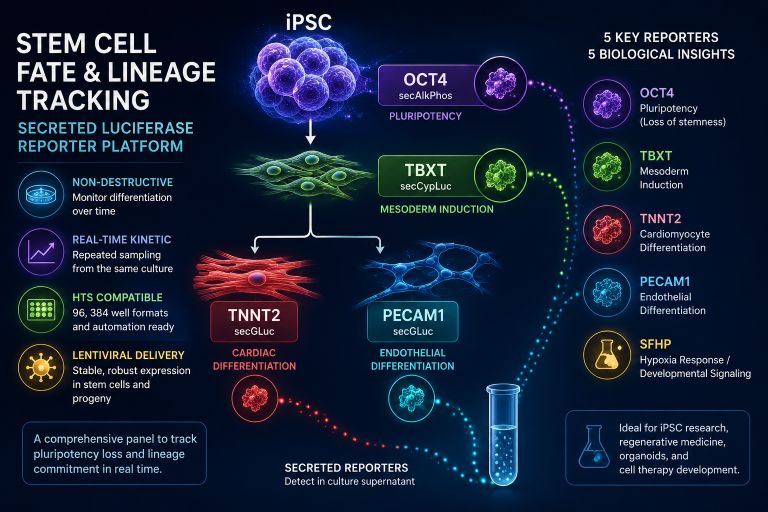
Non-destructive monitoring of stem-cell differentiation
Targeting Systems has developed a proprietary panel of secreted stem-cell lineage-tracking reporter systems designed to monitor pluripotency loss and lineage commitment in real time.
Unlike conventional endpoint assays that require cell lysis, fixation, or destructive sampling, secreted reporter technologies enable repeated monitoring from culture supernatants while preserving the same cell population for continued differentiation, imaging, or downstream validation.
Key Differentiator
Secreted reporter technologies enable repeated, non-destructive monitoring of stem-cell differentiation from the same culture over time without cell lysis, fixation, or endpoint sampling.
Stem Cell Fate & Lineage Tracking Reporters Roadmap
Secreted lentiviral reporters for non-destructive monitoring of stem-cell differentiation.
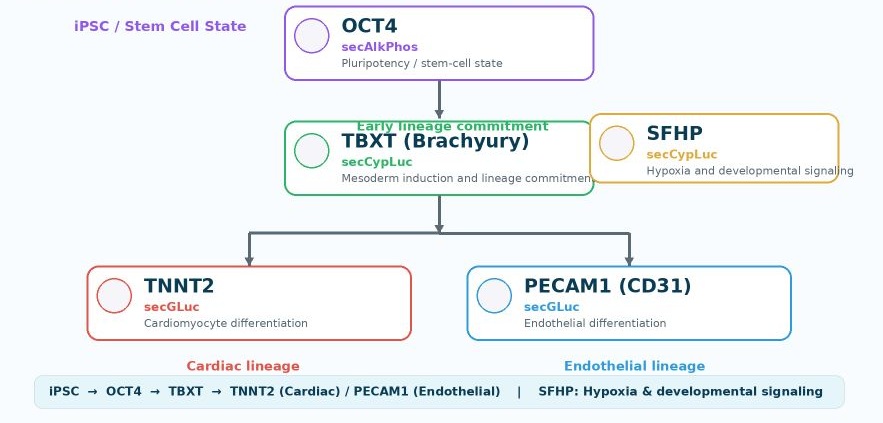
Conceptual progression: iPSC / stem cell state → OCT4 → TBXT → branching into TNNT2 cardiac and PECAM1 endothelial differentiation, with SFHP providing a hypoxia/developmental-signaling readout.
Compact product panel
The LineageBeacon™ Reporter Panel includes:
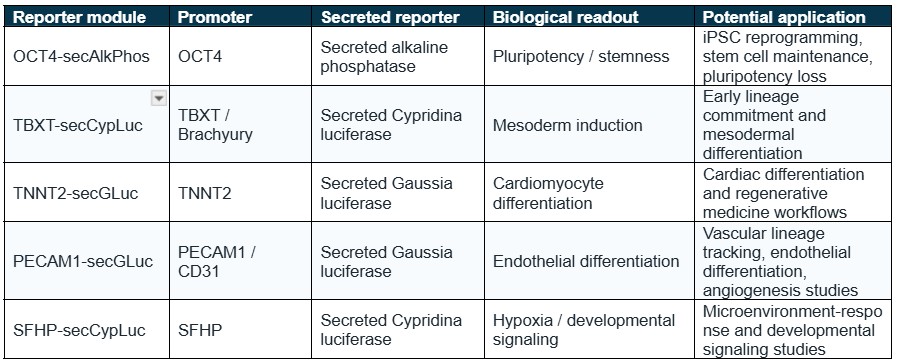
Abbreviations: Gluc=Gaussia luciferase; CypLuc =Cypridina luciferase; AlkPhos-=Alkaline phosphatase; RedFLuc=Targeting systems’ proprietary red-emitting Firefly luciferase
LineageBeacon™ Reporter Panel
Additional functional reporter systems, including NF-κB, NFAT, and CREB-responsive bioluminescent reporters, are available for monitoring cell stress, inflammatory signaling, and pathway activation
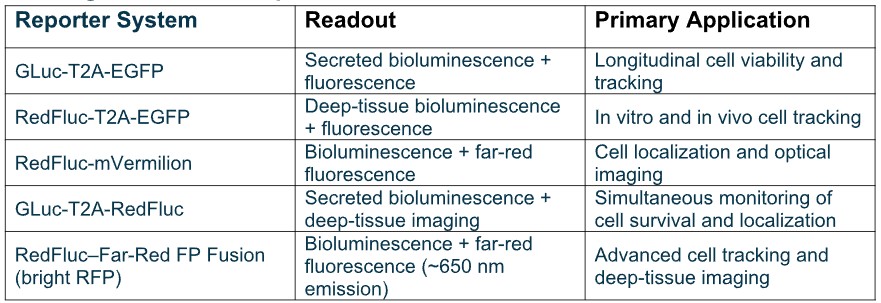
Constitutive Cell Tracking Reporter Systems
Complementary dual-modality bioluminescent and fluorescent reporters for monitoring cell viability, persistence, localization, engraftment, and in vivo imaging
Representative Stem-Cell Tracking and Differentiation Studies
Monitoring Stem Cell Differentiation and Phenotypic Changes
Targeting Systems reporters have been successfully applied to monitor stem-cell differentiation and phenotype transitions. Human AdMSCs expressing GLuc and GFP reporters were induced toward a skeletal muscle lineage through MyoD-mediated differentiation. Reporter-expressing cells exhibited characteristic myogenic morphology and stained positively for skeletal muscle troponin T, confirming successful differentiation. These results demonstrate how integrated fluorescent and bioluminescent reporters can be used to track both stem-cell viability and lineage-specific phenotypic changes during differentiation workflows.
Representative studies have utilized constitutively labeled GLuc-GFP reporter stem cells in conjunction with protein-mediated differentiation strategies to monitor cell survival, growth, and lineage commitment during skeletal muscle, cardiac, and insulin-producing cell differentiation workflows.
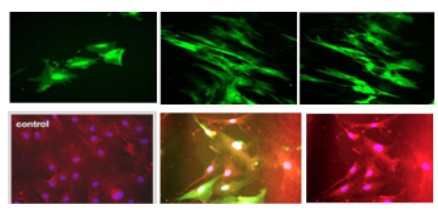
Engineered AdMSCs to study stem cell survival and differentiation: Human AdMSCs engineered with a Lenti-CMV-GLuc-GFP reporter were induced toward a myogenic lineage. GFP fluorescence was used to monitor cell morphology, and skeletal muscle troponin T staining confirmed myogenic differentiation
Longitudinal In Vivo Tracking of Engineered Stem Cells
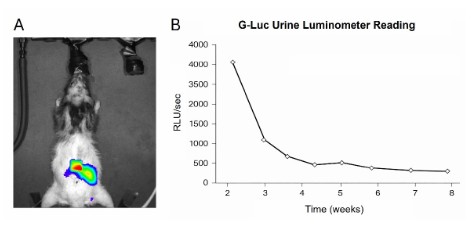
Primary human adipose-derived mesenchymal stem cells (AdMSCs) engineered to express RedFLuc and secreted Gaussia luciferase (GLuc) were successfully monitored following implantation in vivo. Robust bioluminescent signals remained detectable two weeks after implantation of just 500,000 human AdMSCs, demonstrating the sensitivity of the RedFLuc reporter for stem-cell localization. Simultaneously, secreted GLuc activity measured from urine samples provided a rapid, non-invasive surrogate marker of viable cell burden, enabling longitudinal assessment of stem-cell persistence without repeated imaging procedures. These studies demonstrate the utility of complementary bioluminescent reporters for monitoring stem-cell localization, survival, and engraftment over time.
Representative studies have utilized constitutively labeled GLuc-GFP reporter stem cells together with differentiation-inducing strategies to monitor cell survival, growth, and lineage commitment across skeletal muscle, cardiac, endothelial, and insulin-producing cell differentiation workflows.
Key value proposition:
- Non-destructive kinetic readouts from the same cell culture over time
- Simultaneous tracking of pluripotency loss, mesoderm induction, cardiomyocyte differentiation, endothelial differentiation, and hypoxia/developmental signaling
- Compatible with iPSC differentiation, AdMSC research, organoid development, regenerative medicine, and cell-therapy process optimization
- Potential to support screening of media conditions, small molecules, growth factors, and differentiation protocols in multiwell formats
Applications:
LineageBeacon™ enables non-destructive monitoring of stem-cell differentiation using secreted reporter technologies
IPSC Applications
- Track loss of OCT4-driven pluripotency
- Monitor TBXT activation during mesoderm induction
- Follow TNNT2 activation during cardiomyocyte differentiation
- Monitor PECAM1 activation during endothelial differentiation
- Optimize differentiation protocols and screen pathway modulators
AdMSC / regenerative medicine applications
- Evaluate multipotency and lineage priming
- Monitor experimental reprogramming toward pluripotency
- Test cardiac or endothelial differentiation conditions
- Support organoid and tissue-engineering workflows
- Screen culture conditions and regenerative-medicine protocols
Validated Applications
- Longitudinal in vivo tracking of implanted stem cells
- Non-invasive monitoring of stem-cell survival using secreted reporters
- Real-time assessment of stem-cell engraftment and persistence
- Monitoring lineage commitment and differentiation
- Skeletal muscle, cardiac, endothelial, and regenerative medicine applications
- Compatible with iPSC, MSC, organoid, and cell therapy workflows
Partnership/Licensing Opportunities
Targeting Systems welcomes discussions regarding stem-cell lineage tracking, iPSC differentiation, organoid development, regenerative medicine, custom reporter cell lines, lentiviral vectors, sponsored feasibility studies, and technology licensing.