
NIRGlo™ Platform
Next-generation far-red / near-IR bioluminescent reporter systems engineered for ultra-sensitive deep-tissue imaging.
Built through progressive engineering of the patented TS-RedFluc reporter platform originally used in LentiGlo™ prepackaged lentiviral reporter product line.
Maximize recoverable photon flux in living tissue, not simply shift the emission peak.
Parent TS-RedFluc Delivers Exceptional Deep Tissue Sensitivity
Engineered TS-RedFluc platform enables high photon flux and deep tissue detection.
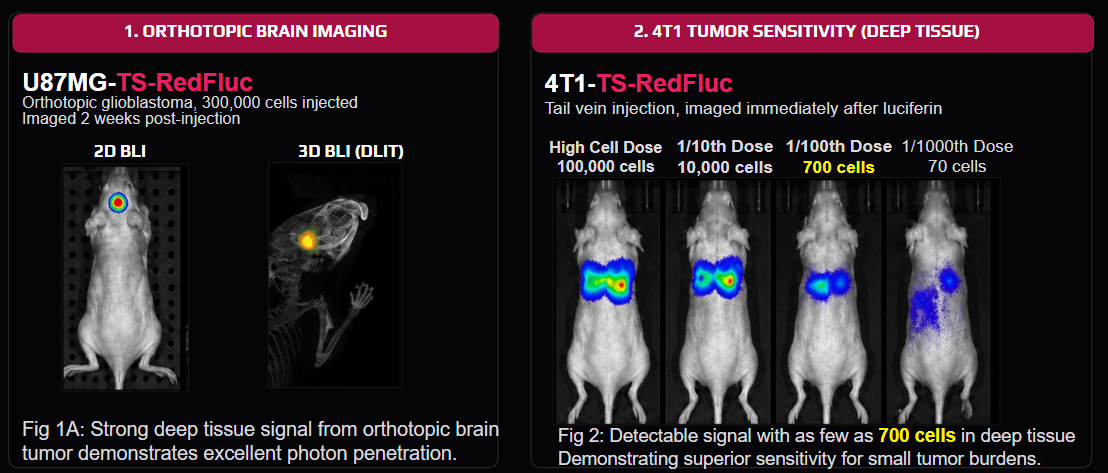
◎ TS-RedFluc reporters were engineered for high photon flux in the far-red / near-IR range, enabling ultra-sensitive imaging of deep-seated tumors and small cell populations.
NIRGlo™ Platform Evolution
Serial engineering of the TS-RedFluc platform for enhanced far-red / near-IR photon flux.
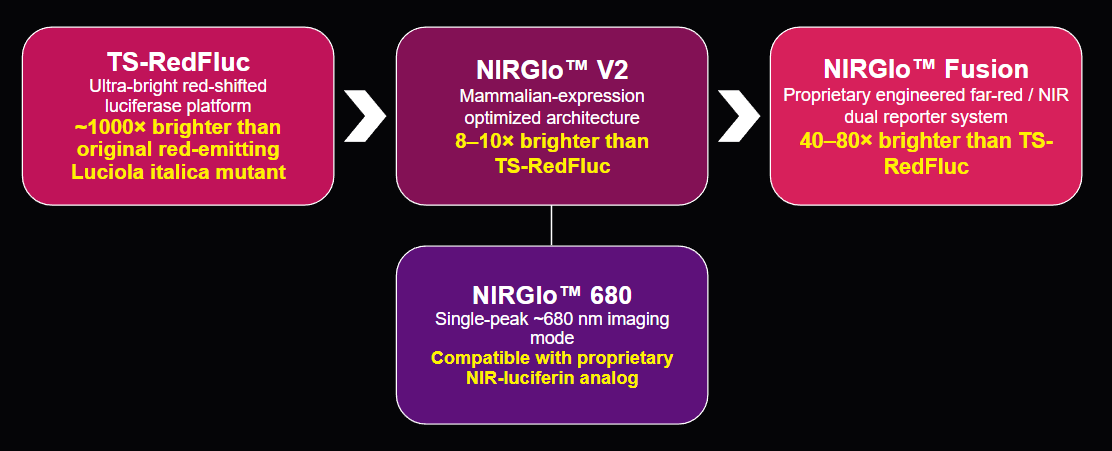
* Deep-tissue imaging data shown in Figures 1 and 2 were generated using the original TS-RedFluc platform; V2 and Fusion architectures are currently under evaluation for deep seated imaging.
V2-TS-RedFluc: Preserving Spectral Profiles
V2-TS-RedFluc increases overall activity while maintaining the critical red-shifted ~620 nm emission window.
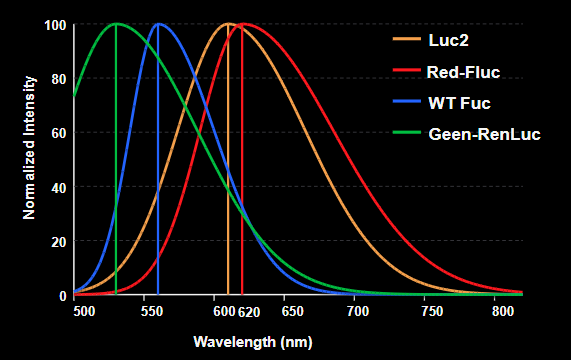 Parental TS-RedFluc Foundation vs Luc2 / WT Fluc (Peak ~620 nm)
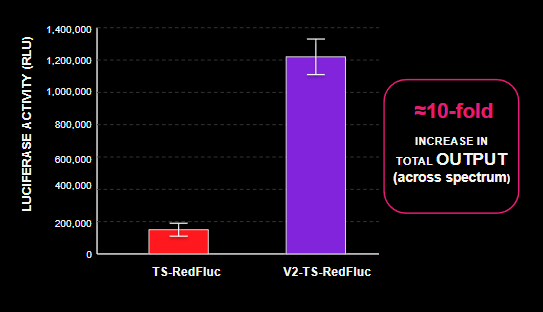 V2-TS-RedFluc vs TS-RedFluc (NIR-Luciferin)
Key Takeaway
V2-TS-RedFluc significantly increases photon output by 10X across the entire spectrum while preserving the ~620 nm peak. This delivers significantly higher photon flux in the Near-IR emission window critical for far-red and near-IR in vivo imaging workflows.
Enhanced Far-Red / Near-IR Flux
V2-TS-RedFluc maintains the spectral profile of TS-RedFluc with an emission max at ~620 nm, expanding far-red photon availability.
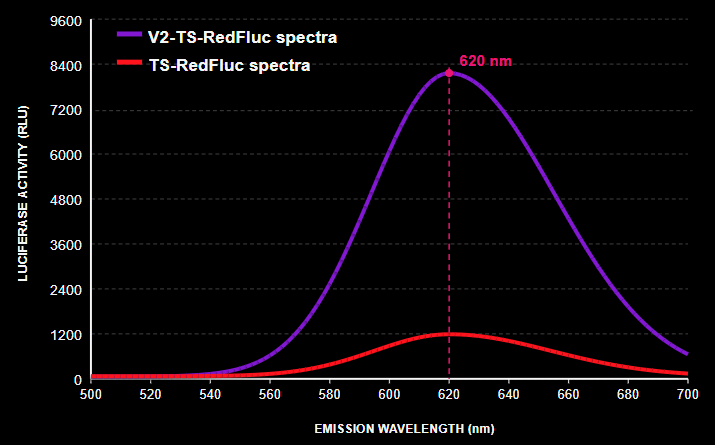 V2 Spectra vs TS-RedFluc Spectra (500 nm to 720+ nm Overlay)
V2-TS-RedFluc achieves ≈10X higher activity and significantly higher photon flux in the far-red, near-IR region.
Photon flux of V2-RedFluc at 700 nm approximately equals the peak 620 nm photon flux of the parent TS-RedFluc platform.
Rational Mutagenesis Architecture: V2-TS-RedFluc is a next-generation luciferase reporter engineered specifically for enhanced in vivo imaging performance and reduced immunogenicity across complex animal models.
NIRGlo Fusion™ Enhanced Architectures
Dual-mode RedFluc–RFP fusion systems result in up to a 9-fold enhanced total photon flux.
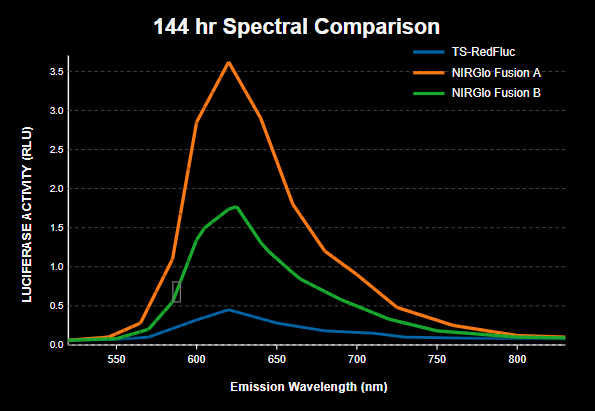 TS-RedFluc vs NIRGlo Fusion A & B curves (550nm - 800nm)
NIRGlo Fusion™ architectures demonstrate up to a ~9-fold enhancement in total photon flux while retaining essential far-red characteristics.
Key Observations
- ✓ Fusion architectures produce substantially higher total photon flux than parental TS-RedFluc platforms.
- ✓ Enhanced far-red / near-IR signal signatures are completely preserved despite dramatic increases in overall brightness.
- ✓ Unexpected photon enhancement may reflect improved intracellular protein stability, advanced folding pathways, or fusion-mediated photonic stability effects.
- ✓ Explicitly engineered for ultra-sensitive deep-tissue monitoring and longitudinal, multi-week tracking workflows.
NIRGlo™ 680: Single-Peak ~680 nm Imaging Mode
Compatible with a specialized near-infrared (NIR) D-luciferin analog for maximum deep-tissue peak performance.
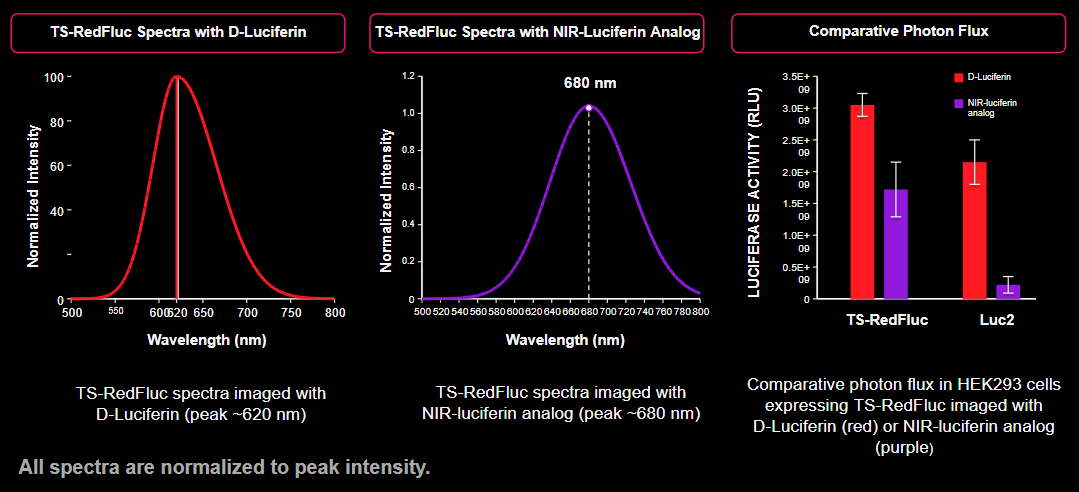
Substrate-Driven Spectral Shifts
Optical measurements illustrate a direct comparison between imaging profiles. When paired with standard D-Luciferin, the platform preserves its classic ~620 nm baseline. Introducing our engineered NIR-luciferin analog dynamically shifts the engine to run at a standalone 680 nm peak emission window.
* Note: All reference curves in the evaluation panel (comparing TS-RedFluc vs Luc2 across D-Luciferin and purple NIR-analog states) are fully normalized to peak intensity values.
Interested in the NIRGlo™ product line or custom stable cell-line generation?
Contact Targeting Systems to discuss NIRGlo™ reporters, LentiGlo™ vectors, custom stable tumor cell lines, or global development partnership opportunities. Detailed technical application notes are available upon request.